

Explaining IIOT: Definition, Types, Expert Recommendations
Industrial Internet of Things (IIOT) is a critical part of the automation of industrial operations as well as the fourth industrial revolution, commonly known as Industry 4.0.
Think of it this way: traditional industrial operations often rely on people checking equipment, recording measurements, and identifying problems when something goes wrong. With IIoT, connected devices can collect this information continuously, making it easier to spot unusual activity, track performance, and respond to problems before they become more expensive to fix.
This technology is helping transform traditional factories and industrial facilities into smarter, more connected environments where people, machines, and software can work together.
But what exactly is IIoT, how does it work, and what should businesses consider before implementing it? Let's get into that.
Explaining IIOT: What is IIOT?
IIoT refers to the use of connected sensors, devices, machines, and software to collect, exchange, and analyse data from industrial operations.
For example, imagine a manufacturing plant where hundreds of products move along an assembly line every hour. Instead of manually counting each item or inspecting every product for defects, the plant can use connected sensors and machine vision systems to track production, identify irregularities, and record the results.
The same principle applies to energy management. Connected meters and sensors can help businesses monitor electricity consumption, equipment performance, and operating conditions across a facility. Information that might otherwise go unnoticed until the monthly utility bill arrives can become visible throughout the day.
This is what makes IIoT useful. It turns physical activities and equipment performance into information that businesses can monitor and act on. Especially information or data that may have been otherwise invisible or difficult to track, like electrical parameters ( such as voltage, current, and power factor) or the flow pressure of liquid beneath pipes.
IIoT Vs IoT: What's the Difference?
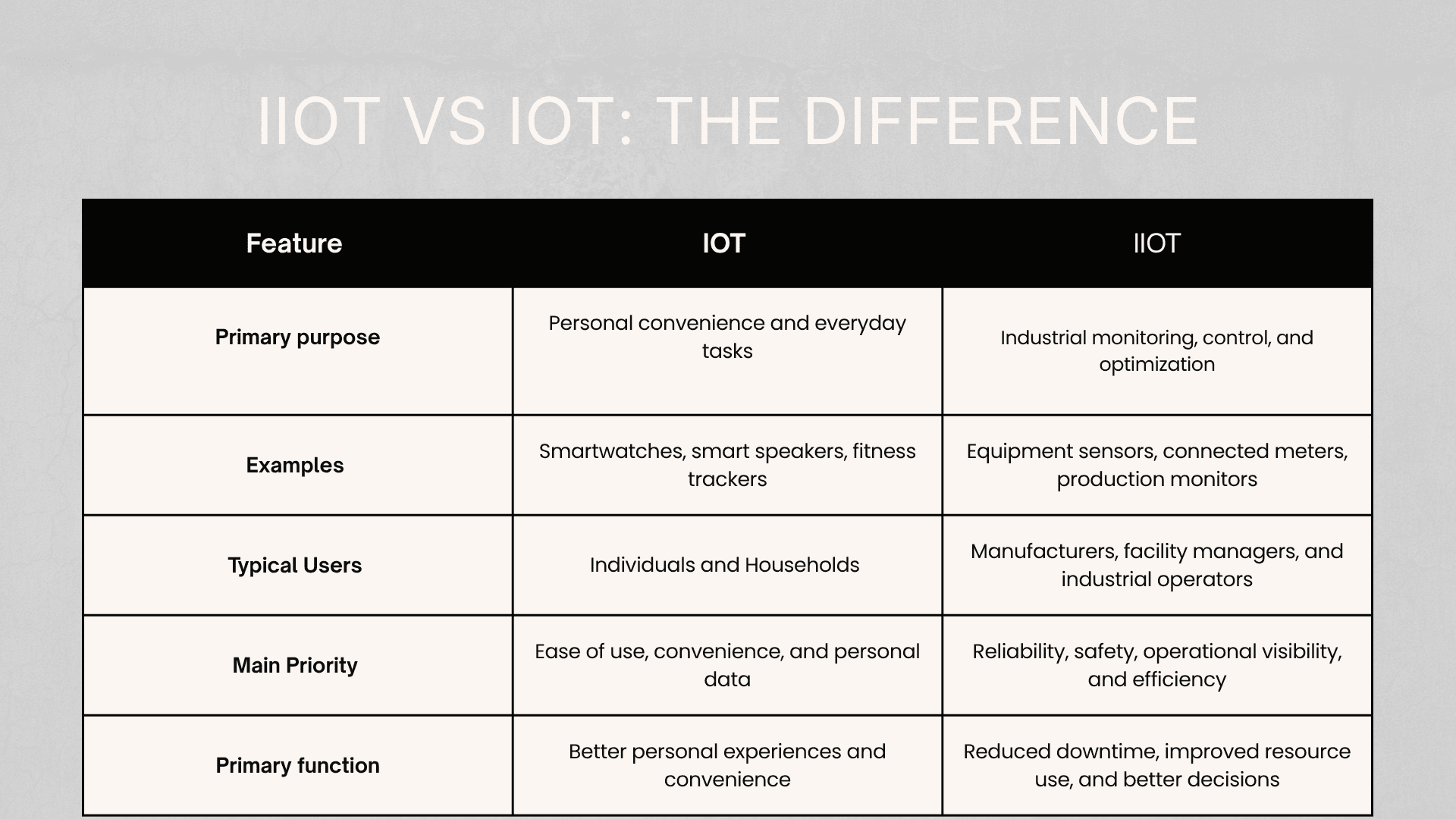
The main difference between IoT and IIoT is the distinction in their applications.
The Internet of Things (IoT) refers to physical devices connected to networks so they can collect, exchange, or act on data. These devices can be found in homes, offices, hospitals, factories, and many other environments.
Consumer IoT includes devices such as smartwatches, smart speakers, smart TVs, and fitness trackers. These technologies are often designed to improve personal convenience, health tracking, entertainment, or everyday tasks.
Industrial IoT applies similar principles to industrial and commercial operations. Rather than focusing primarily on individual users, IIoT helps businesses understand how their equipment, production processes, and other operational assets are performing.
The key difference is not simply the type of device or whether it connects to the internet. It is the environment in which the technology operates, the problem it solves, and the requirements it must meet.
Types of IIoT Solutions
1. Energy Management
Energy is a major operating expense for many industrial businesses. Yet knowing how much electricity a facility consumes is only part of the problem. Businesses also need to understand when energy is being used, which equipment is consuming it, and how consumption relates to operating activity.
IIoT-based energy monitoring uses connected meters, sensors, and monitoring systems to make energy data more accessible.
For example, a factory may discover that certain equipment continues drawing power outside normal production hours. A commercial building may identify differences in consumption between locations or notice that its generator operates longer than expected.
With better visibility into these patterns, facility and operations teams can investigate inefficiencies and make more informed decisions about energy use.
2. Condition Monitoring and Predictive Maintenance
Industrial equipment does not always fail without warning. Changes in vibration, temperature, pressure, or other operating conditions can indicate that a machine is developing a problem.
Condition monitoring uses sensors to track these changes, giving maintenance teams better visibility into equipment performance. Predictive maintenance takes this a step further by analysing available data to identify patterns that may indicate an impending failure. This can help businesses plan maintenance before a breakdown disrupts operations.
For example, a factory monitoring the temperature and vibration of its motors may notice unusual readings that prompt an inspection before the equipment fails.
3. Production and Process Monitoring
Manufacturers need to understand how efficiently their production lines operate. IIoT solutions can collect information about production rates, machine availability, operating conditions, and process irregularities. This makes it easier to identify bottlenecks, detect deviations, and understand why output may be falling below expectations.
Rather than relying entirely on periodic manual reports, production managers can use current operational data to investigate issues and make adjustments.
4. Asset Tracking and Monitoring
Industrial businesses often manage multiple machines, vehicles, tools, and other assets across large facilities or different locations. IIoT-enabled tracking solutions can help businesses monitor asset location, usage, and status, depending on the technology deployed.
This is particularly useful for businesses that need to coordinate equipment across warehouses, factories, construction sites, or distributed facilities.
Examples of IIoT in Industrial Operations
IIoT applications vary depending on the industry and the challenges a business needs to solve. IIoT examples include:
- Manufacturing: IIoT in manufacturing is becoming increasingly important. Connected sensors monitor machine performance, production conditions, and equipment health to help identify irregularities and reduce unplanned downtime.
- Healthcare facilities: Monitoring systems can track the operating conditions (eg: temperature) and energy consumption of critical building equipment, helping facility teams identify issues that require attention.
- Commercial buildings: Connected systems can monitor HVAC performance, electricity consumption, and other building operations across one or multiple locations.
- Warehousing and logistics: Tracking devices can provide information about the location and status of equipment, vehicles, and inventory.
- Energy-intensive industries: Connected meters and equipment sensors can help businesses monitor electricity consumption, generator performance, and other aspects of their energy infrastructure. An example of this is Pai Enterprise.
Across these applications, the underlying idea and process are the same: collect useful information from physical operations, make it accessible, and use it to improve decision-making.
Benefits of Industrial IoT (IIoT)
Using IIoT technology or software is not just about connecting machines. When the collected data is reliable and used effectively, it can help businesses improve important aspects of their operations.
Better Operational Visibility
It is difficult to manage what you cannot see. When equipment performance, production activity, and resource consumption are monitored through connected systems, businesses have a clearer picture of what exactly goes on across operations.
This is especially useful for managing multiple facilities or assets across different locations.
Reduced Downtime
Equipment failures can interrupt production, delay service delivery, and increase maintenance costs. Monitoring equipment conditions can help teams identify warning signs earlier and investigate potential problems before they cause major disruptions.
Although IIoT cannot prevent every failure, it can give businesses more information to support timely maintenance decisions. It can also ensure that incident management is undertaken with utmost accountability and resolved on time.
Improved Resource Utilisation
IIoT can help businesses understand how resources such as electricity, water, and fuel are being used. For instance, energy monitoring may reveal unnecessary consumption outside operating hours or differences in energy use across similar facilities. These findings can help businesses investigate waste and identify opportunities for improvement. IIoT can help reduce energy costs.
More Informed Decision-Making
When operational data is available and presented in a useful format, managers can make decisions based on actual performance rather than assumptions alone.
They can compare operating periods, investigate unusual activity, and identify patterns that may not be obvious from occasional inspections or monthly reports.
Better Coordination Across Teams
Industrial operations involve facility managers, maintenance teams, finance departments, and other stakeholders. These different teams and roles have different priorities even though they all contribute to and make up the objectives of the business. Because of this, they might often clash, keep duplicate data, or create documentation that may sometimes contain too many discrepancies.
IIoT technology can transform this chaos into unified and seamless cross-team coordination. IIoT systems can make relevant information more accessible to these teams, helping them coordinate their work and understand how operational decisions affect the wider business.
Expert Recommendations: What Should Businesses Consider Before Implementing IIoT?
IIoT can improve operational visibility, but adopting connected devices without a clear plan may create more data without solving the underlying problem.
Before investing in an IIoT solution, businesses should consider a few important factors.
1. Start With a Specific Operational Problem
Before choosing sensors or software, identify what the business needs to understand or improve. You may consider the disruption of production due to downtime. Or pinpoint other problems. Are energy costs and consumption difficult to explain? Is it challenging to compare performance across multiple facilities?
Starting with a specific problem makes it easier to select the right technology and measure whether the investment is delivering value.
2. Consider Compatibility With Existing Equipment
Industrial facilities often use equipment from different manufacturers, installed at different times and designed to operate with different systems. Before implementing IIoT, it is important to know whether the proposed devices and software can communicate with their existing infrastructure. They should also understand whether additional sensors, gateways, or integration work will be required.
A solution that fits the existing environment is generally more practical than one that requires replacing equipment unnecessarily.
3. Prioritize Data Quality and Security
Connected devices are only useful when they provide reliable information. Businesses should consider sensor accuracy, installation quality, data coverage, and how often readings are collected. The Pai sensor device collects voltage, current, power factor, and energy consumption data from energy meters in real time with up to ±0.5% accuracy.
Cybersecurity is equally important. Connected industrial systems can introduce additional risks if they are not properly secured. Businesses should assess access controls, network security, software updates, and how operational data is stored and transmitted.
4. Think Beyond Data Collection
Collecting data is only the first step. Businesses also need a way to interpret the information and decide what to do with it. A dashboard may show that energy consumption has increased, for example, but teams still need to investigate the cause and determine the appropriate response. IIoT technologies like Pai Enterprise does not only merely collect data, it also run optimization reports that recommends practical solutions to operate efficiently and effectively. Automated weekly reports also point out or indicate a reason for a deviation, such as higher energy consumption, voltage spikes, or energy costs. Rather than just showing an increase or decrease. Pai enterprise also recommends operational decisions to salvage deviations.
The most useful IIoT solutions connect data collection with analysis, reporting, and operational decision-making.
5. Consider Scalability
A business may begin by monitoring one machine, one building, or a single facility. As its needs grow, it may want to extend monitoring to additional equipment or locations.
Choosing a solution that can accommodate future requirements can make expansion easier. Businesses should also understand its limitations, including which assets it can monitor, what information it can collect, and which integrations it supports. With Pai Enterprise, an intelligent IIoT system for energy orchestration and management, net new locations, devices, and energy assets can easily be added with full technical support in less than 48 hours.
Pai Sensors: Industrial IoT for Energy Management
Energy management is one area where IIoT can make a practical difference, particularly for businesses that depend on multiple power sources or operate across several locations.
When a business relies on the grid, generators, solar installations, batteries, and inverters, understanding its energy operations can become complicated. Information may be spread across different devices, monitoring interfaces, and manual records.
Pai Sensors are IIoT sensors that use connected sensing technology to support energy monitoring by collecting information from relevant equipment and electrical systems. This data can help businesses gain better visibility into energy consumption and equipment performance, depending on the sensors installed and the infrastructure being monitored.
Pai Enterprise does not just collect information or data from different energy assets. Pai Enterprise helps commercial and industrial operators understand what the data means for their operations. With Pai Enterprise, businesses can answer questions like: how much energy is being consumed, are there differences in performance across locations with the same setup, does the solar energy system setup yield more ROI? What location or equipment contributes to more energy consumption and costs? How can my facility be set up to operate optimally and cost-effectively?
With better visibility on Pai Enterprise, facility managers and other decision-makers can investigate unusual consumption patterns, understand equipment usage, and make more informed decisions about their energy operations.
For businesses looking to improve how they monitor and manage energy across their facilities, Pai Enterprise combines IIoT software and sensors to provide a foundation for moving from limited visibility to more informed, data-driven energy management.
Work with leading data scientists, engineers, and technical talent to help integrate Pai Enterprise's cutting-edge IIoT technology into your day-to-day industrial operations. Contact sales to book a demo plus a free energy orchestration/ cost reduction consultation session.